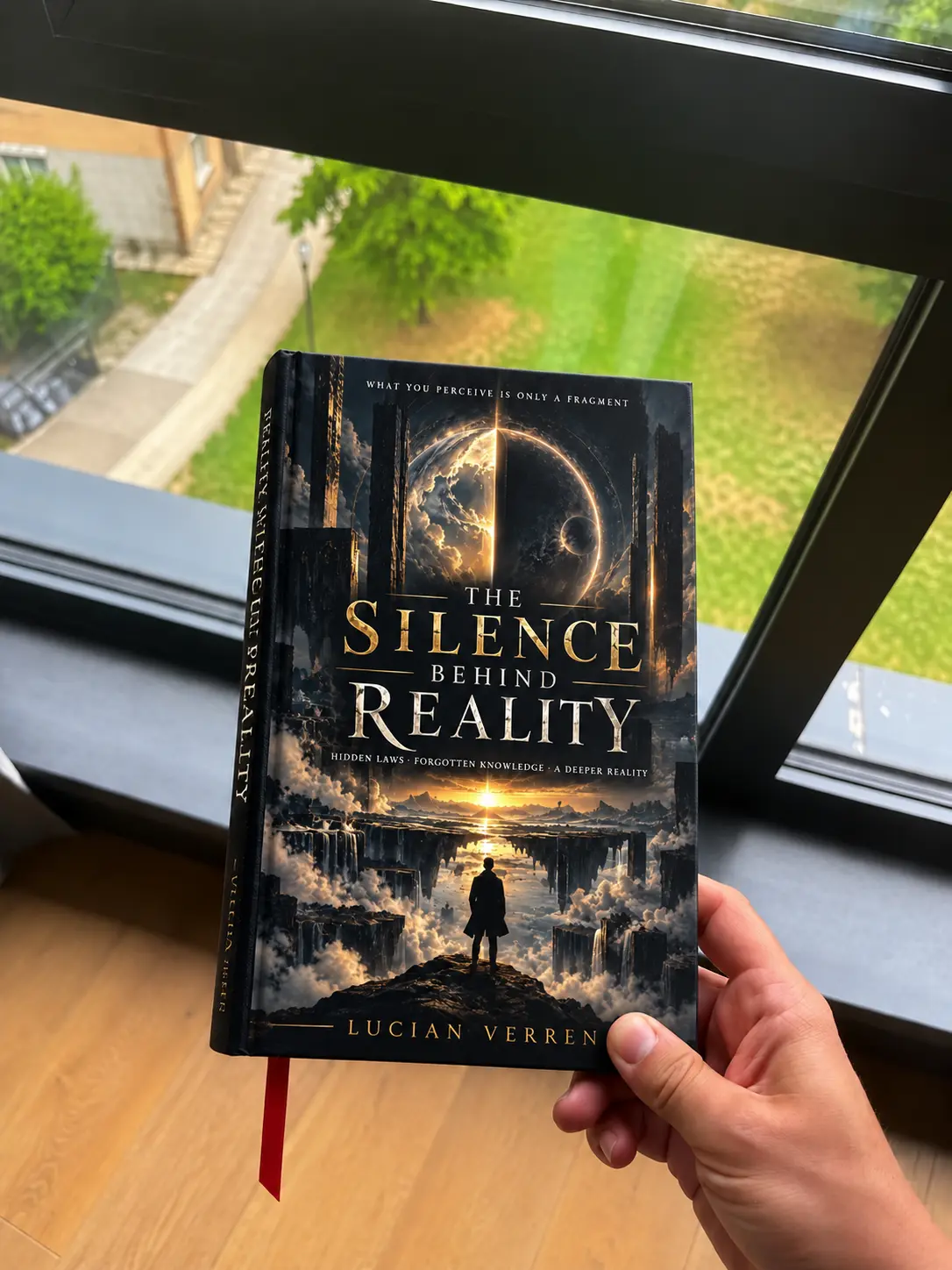

A Facebook post
Lucian Verren · Public post
A random man on Facebook just wrote something brilliant
It’s been several hours since I finished The Silence Behind Reality, and I can’t continue with my normal daily activities and routines unless I publicly share my thoughts.
I honestly can’t remember the last time a book by some random author affected me like this one did. And since I see that very little is being talked about online regarding this entire story surrounding the book and its author, I decided I would be the one to explain just how deep this rabbit hole really goes.
The name of the author is Lucian Verren.
I first came across his name through Facebook.
At first, there was nothing particularly unusual about it. Just another profile buried among millions of others, posting strange thoughts about consciousness, reality, human behavior, artificial intelligence, and the direction our world is heading.
But then I started reading.
And something felt different.
Verren wasn’t writing like someone trying to build an audience. He wasn’t constantly promoting himself, selling some lifestyle, or begging people to believe him.
Some of his posts were almost uncomfortable to read because of how calmly he wrote about things most people would consider insane.
One sentence in particular stayed with me:
“The most important part of reality is the part you were trained not to notice.”
That sentence was what eventually led me to his book.
The Silence Behind Reality.
And I genuinely wish I could explain what happened after I started reading it without sounding completely insane.
Verren doesn't begin by asking you to believe him.
He does something much more uncomfortable.
He asks you to observe.
To look at your own thoughts.
To notice how much of what you call "yourself" existed before you consciously chose it.
Your language.
Your fears.
Your ambitions.
Your definition of success.
Your understanding of time.
Your expectations of other people.
Even the internal voice you experience as you.
And then he asks a question that followed me through the entire book:
If most of the structure inside your mind was placed there before you were old enough to question it, how much of your reality have you actually chosen?
That was where the book got me.
Because The Silence Behind Reality isn't really about some giant secret hidden underneath the physical world.
It's about something far more unsettling.
It's about the possibility that the secret has always been directly in front of us.
We simply stopped noticing it.
Verren describes human beings as creatures living inside layers of interpretation. We don't experience reality directly, he argues. We experience a reconstruction of reality created by the brain — filtered through memory, expectation, language, emotion, fear and attention.
And if you can influence those filters, you don't necessarily need to control someone's physical environment.
You can control the reality they experience inside it.
I had to put the book down after that section.
Not because the idea itself was impossible to understand.
Because it was almost too easy to understand.
I started thinking about how many hours of my life had disappeared into screens. How many things I wanted simply because I watched other people wanting them. How many opinions I had repeated without remembering where I originally heard them.
Then came the part of the book that genuinely disturbed me.
Verren writes about what he calls the architecture of attention.
His argument is simple: the most valuable thing you possess isn't money.
It isn't time.
It's attention.
Because whatever repeatedly receives your attention eventually begins constructing your internal world.
Control what a person sees every day, and eventually you influence what they think about.
Influence what they think about, and you influence what they fear.
Influence what they fear, and you influence their decisions.
Influence their decisions long enough...
and they will build the cage themselves.
That sentence stayed in my head.
They will build the cage themselves.
The book gets much stranger from there.
Consciousness.
Artificial intelligence.
Synchronicity.
Death.
The perception of time.
The relationship between observation and reality.
Ancient ideas about the human mind.
The strange feeling that consciousness may be something fundamentally different from what we've been taught to assume.
There are sections where Verren discusses whether advanced technology will eventually become indistinguishable from what ancient civilizations would have called spiritual phenomena.
There are sections about humanity slowly outsourcing memory, judgment, creativity and eventually identity itself to machines.
And there is one particular chapter about AI that genuinely made me close the book and sit in silence.
His fear isn't that machines become human.
It's that humans become machine-like first.
Predictable.
Optimized.
Constantly stimulated.
Unable to sit quietly.
Unable to tolerate boredom.
Unable to think without external input.
Unable to distinguish their own desires from desires placed inside them.
A civilization doesn't lose its humanity when robots begin thinking, Verren argues. It loses its humanity when people stop.
That line hit me harder than anything I had read in years.
And this is where the title finally made sense to me.
The Silence Behind Reality.
Verren repeatedly returns to silence.
Not simply physical silence.
Mental silence.
The tiny space before a thought appears.
The moment before you instinctively reach for your phone.
The fraction of a second between something happening and your mind assigning meaning to it.
He believes that space is incredibly important because it is one of the few places where conditioning temporarily loses its grip.
And once I understood what he meant, I started noticing it everywhere.
Something strange happened while I was reading.
At one point I became aware that my room was completely silent.
No television.
No music.
No video playing in the background.
My phone had been sitting untouched beside me for nearly two hours.
That almost never happens.
I just sat there holding the book.
And for perhaps thirty seconds, I became intensely aware of everything around me.
The sound of my breathing.
The weight of my body against the chair.
Light coming through the window.
The fact that I was alive.
I know how ridiculous that probably sounds.
But there was something deeply unsettling about realizing how rarely I actually experience my own life without simultaneously distracting myself from it.
That's when the book stopped feeling like entertainment.
It became a mirror.
And mirrors aren't always pleasant.
There are ideas inside The Silence Behind Reality that I don't agree with. There are theories I can't prove. There are sections that go far beyond what I'm personally willing to accept as fact.
But strangely, that didn't make the book weaker for me.
It made it more interesting.
Because I don't think Lucian Verren is asking the reader to worship his conclusions.
He is asking the reader to become difficult to program.
To question automatic behavior.
To protect attention.
To remain curious.
To preserve the parts of human existence that cannot easily be quantified.
Love.
Creation.
Risk.
Friendship.
Nature.
Physical experience.
Silence.
Wonder.
The ability to change your mind.
The ability to do something nobody predicted you would do.
And perhaps most importantly:
the ability to remain human in a world increasingly designed to understand you as data.
I finished the final pages earlier today.
Then I closed the book.
For several minutes, I did absolutely nothing.
And something felt different.
The room was the same.
My life was the same.
The world outside my window was the same.
But I was looking at it differently.
Maybe Lucian Verren understands something profound.
Maybe he's wrong about half of it.
Maybe The Silence Behind Reality is philosophy disguised as something stranger.
Maybe that's exactly why it works.
I genuinely don't know.
But I know this:
I have consumed thousands of hours of content that disappeared from my mind almost immediately.
This didn't.
And I suspect I'll be thinking about certain pages of this book years from now.
So if you eventually come across Lucian Verren's name or The Silence Behind Reality, don't approach it looking for someone to tell you what to believe.
Read it slowly.
Question it.
Argue with it.
Put it down when something makes you uncomfortable.
Then ask yourself why it made you uncomfortable.
And when you finish, spend ten minutes without your phone.
Without music.
Without another person's voice entering your head.
Just sit there.
Because after reading this book, I'm beginning to wonder whether the silence we've spent our entire lives trying to escape... might be the only place where reality has been speaking to us all along.
I don't know who Lucian Verren really is.
I don't know how much of what he wrote I believe.
But I understand the title now.
And somehow, that bothers me more than if I didn't.
I've said what I needed to say.
What you do with it is entirely up to you.